![]() |
|||||||
|
MAC Swimmers You Tube Channel ![]() Convert Metric Times Achieved in a 25-Meter or 50-Meter Pool to an Equivalent Time for a 25-Yard Pool, or Vice-Versa |
Club News & Information
|
||||||
![]() |
![]() |
![]() |
![]() |

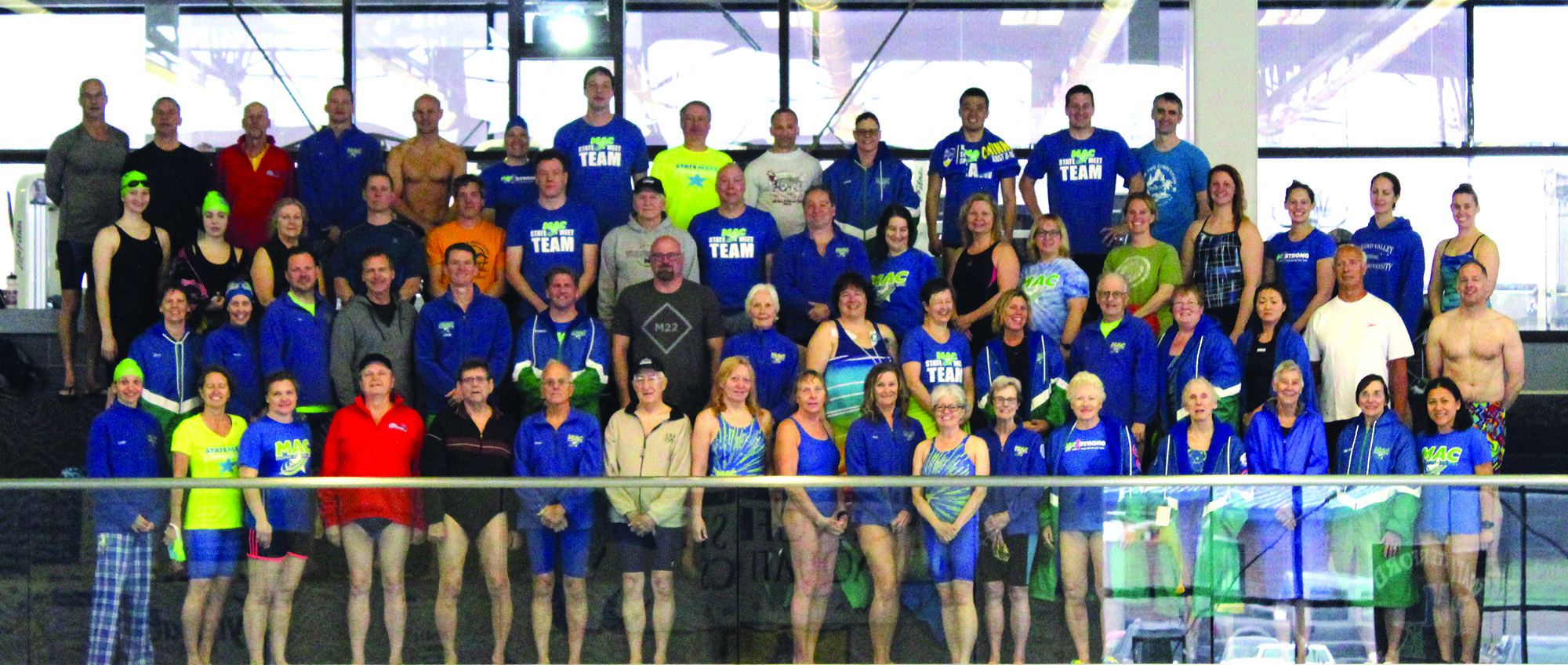
MAC dominated the meet, there would have been NO meet just a small social gathering without us. We had 21 swimmers in attendance.
Front Row: Angela Haddad, Suzanne "Gunnie" Grebe, Andy Kennedy, Julie Martha Amis, Bill Palmer. Middle Row: Steve Marshall, Mike Smith, Matt Pratt, Patrick Sturdy, Jacqueline Thorpe, Back Row: Kitty Vander Brulle, Jim Izzi, Erika Thompson, Lisa Pollack Melissa Richardson, Marilyn Reichenbach, Elizabeth Schmaltz, Joannie Eastridge.

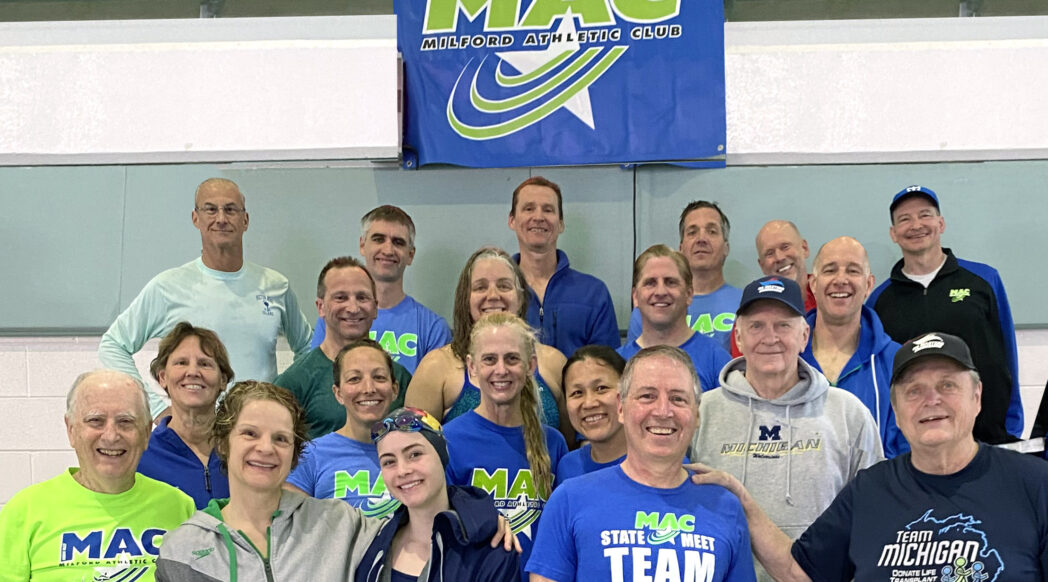
Meet was great. Patrick Sturdy, Elizabet Schmaltz and Ron Vandekerckhove swam away with Blue Ribbons. Here is a pic of the three of us after the meet practicing our kickline routine - GO MAC!

MAC was well represented at the Munley Meet. Swimmers included Marilyn Reichenbach, Nathalie Gordon, Julie Smith, Melissa Snody, Melissa Richardson and myself. All the MAC swimmers did a great job.
Brice received Silver Metal in the 400 free, and a Silver Metal in the 200 free. A good time by all and a big thanks to Suzanne, and the MAC teams help. Lots of bling in Huron valley this weekend. All swimmers brought home medals. One of our newest young swimmers took gold in back stroke.

MAC Members, Bill palmer and Patrick Sturdy at USMS Spring Nationals - April 26-29, 2012 in Greensboro NC, as members of the Michigan Masters Swim Team.
To view the photo slide show... CLICK HERE
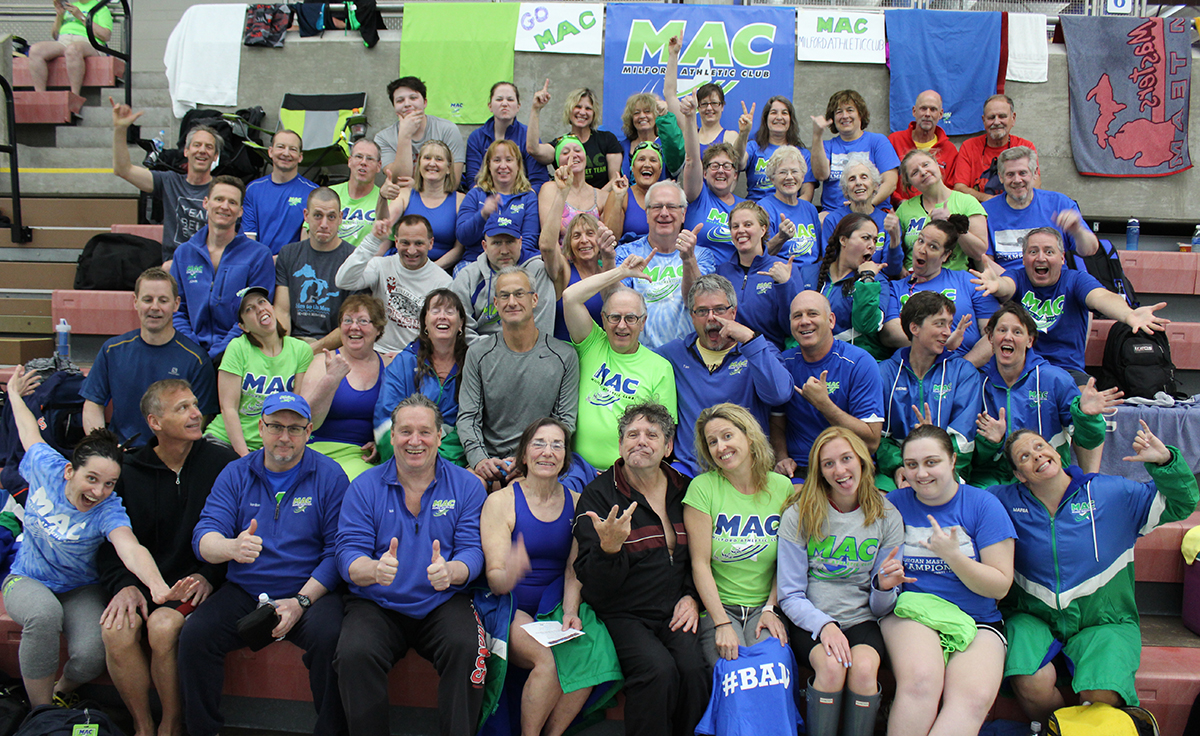
WE had unrivaled success at state meet and that is what it is ALL about...coming together as a team having a good time and swimming some BEST times. The points and the awards as just an added bonus but NOT the focus. There is NOTHING more rewarding as a coach than to have a team that comes together and trusts my judgement and steps out of their comfort zone for the benefit of the team. SO many folks swam "odd" events to challenge them self , help the team and take a leap of faith in the belief I had in them. We walked away with confidence, camraderie and a burning desire to return next year and kick some serious @_^$_!
We fielded a team of 69 swimmers
33 men ... 57% state meet rookies
36 women ... 46% state meet rookies
overall a team composed of 54% rookies...WOW!
High Point Winners for their age group CONGRATULATIONS
they earned the most points in individual events of all swimmers in their group
Anne Hunt 70-74
EJ Charron 65-69
Tom Neal 60-64
Maria MacGregor 40-44
Brittany Balikatz 18-24
MANY swimmers were in the top 3 for points in their age group
State records were set by the 55+ women's relay (Ann H, Marilyn R, EJ C, and Joanie E) EJ Charron, Megan Lassen, Suzanne Grebe and YOU
A special award of inspiration was presented and accepted by the ENTIRE team on Jody Jochman's behalf.
Overall FACTS:
The women finished 2nd in the large team category by 23 points!
Finished 3rd in 2011 and in 2010 was the small team winner
the men finished 4th overall in the large team category...their FIRST time in the large team category
finished 9th in 2010 and 2nd in small team division and 13th in 2010 The team was 2nd overall by less than 200 points with a team of 69 in large team division
finished 3rd last year with a team of 50 in large team division. Finished 7th in 2010 with a team of 33 overall and 3rd in small team division. NOW for the stunner in 2009 we had a team of 5 attend state meet and in 2008 we had a team of 3
the team started in 2006 with the "Fab 5" of whom Gloria Raupp, Janette Heaton and Gary Krimmel have the honor of belonging to, they are your ROOTS!
IF this is being part of building something great I don't know what is!
To view the photo slide show... CLICK HERE
Thanks to you our team of three raised $1,376.00 for Special Olympics! Jim Young, Sheryl Walsh and Susan Moilanen costumed up, took a dip and had a great time the entire time. Yes, the water was COLD! Yes, they'd do it again in a second!
To view the photo slide show CLICK HERE
USMS "Swimmer" Magazine did a feature article about Brice, and Suzanne in the May 2011 Issue. TO VIEW... click here
Are you hoping to get in more running time in the New Year?
We will be running on Tuesdays about - 5:00p.m. - CHECK YOUR MAC-GOOGLE GROUP EMAILS, for exact dates, times and locations.
The Following information is for beginning runners. (Galloway's Book on
Running)
We have all heard horror stories about the pain and agony of the first
week of running. In fact, this is probably why so many people give it up
soon after they start, or say they are bored, or go on about how they
hate running. They never get past that painful stage.
Starting any new activity takes courage and strength. To cross from the
known to the unknown requires a leap of faith. Newton's law applies: a
body at rest tends to stay at rest. Once you overcome the inertia and
get past the painful stage, the reverse law applies: a body in motion
tends to stay in motion. If you start slowly, gradually increase the
exertion through a series of small steps, and rest adequately
throughout, you can improve your condition steadily with little risk of
soreness or injury.
Set aside an hour to run each week with MAC.
Monitor your pulse rate. The key to strengthening your heart is keeping
your pulse rate high enough, but not too high. Research by Dr. Kenneth
Cooper at eth Aerobics Research Institute and by others has shown the
threshold level to be 70 - 80% of your Maximum heart rate. This isn't
necessary in the beginning; but after you've established a program,
maintaining this heart rate for 30 min, three times a week will
strengthen your lungs and heart, improve circulation of the blood and
oxygen and tone up you muscles. (Galloway's Book on Running)
Two methods of Calculating Maximum Heart Rate
1 Have a maximum oxygen uptake test performed.
This is done on a treadmill and is very strenuous, but gives you the
most accurate measure of the
maximum.
2. Subtract your age from 220
Example:
220
- 43 years old
177 Max. Heart Rate
Then take 70 - 80% of that as your
target zone
Example:
177 x 70% = 124 Threshold rate.
Most runs should show a heart rate of 70% or
slightly higher. On speed days the heart rate will go up to 80% and even
90%
5 minute warmup at your own pace
Lunge the long straightaways, jog the curves for 1 lap - This is NOT fast, take your time and do it correctly. Knees should not come past your ankles.
Run at 75-80% effort 4 1/2 laps (equal to 1/2 mile) This should be quick. You should be breathing hard and not able to carry on a conversation.
(Beginners run 2 laps at 75% effort)
Jog 2 1/2 laps for recovery
(Beginners jog 1 lap)
Repeat the lunge, jog, lunge, jog for one lap. Follow with the 4 1/2 laps or 2 laps at 75-80% and appropriate jogging recovery laps.
Do 5 repeats all together.
(Beginners can do 4.)
Hold a plank for 2:00.
Left side plank for 1:00.
Right side plank for 1:00.
Stretch, hydrate and have some protein.
CONGRATS to the MAC runners from the Crim...nice job Rick and Gary and Tim on organizing our team...Gary, Jeff, Jim, Don, Tony, Christine, Rick, Amanda, Susan, Pam, JoAnn, Terese, Jim, Tim, Terra, Bryan Hatfield and Gary's Friend.

A BIG THANK YOU to David Mansky DPM PC of Mansky Podiatry for sponsoring the team, and providing the CoolMax team shirts!
It is quite true that running can be hard on bones and joints. Many doctors suggest alternative sport as a means of exercise with less potential for injury. For example, swimming is regarded as gentle yet effective exercise. I say "gentle" lightly for those doctors who have not swam with sergeant gunny!
In all seriousness though, a swim workout uses less of the body's real weight which is minimized due to buoyancy. As a result, swimming is one of the main exercises recommended by doctors for recovery from injuries.
However, when done with proper warm-up/cool-down and equipment (very minimal in price) running is a very beneficial sport. First of all, runners seldom have weight issues. Running is a highly effective form of aerobic exercise. In addition, the heart also benefits because of the influx of oxygen-rich blood from increased circulation. This also improves the immune system and strengthens the musculoskeletal system. Running also helps flush out toxins from the body, reduces stress (which is a root cause or basis of many illnesses), and costs very little. Although it may be cold during these winter months, running outside gives the body a chance for good air exchange.
As previously stated, running is of very little cost. The only real investment is a good pair of running shoes (alternating between two or three pair if possible). Anyone who has run with the group has heard me say that when it hurts, stop! I think this is especially true when related to joint (hip, knee), or shin pain. If you are like me, I hate to stop training for a few days, or week when I am on a roll with my routine. Running with shin pain, IT band pain, or joint pain can lead to more than a few days off. It is better to rest the body when it gives you a sign, than to push the risk of a more serious injury that will ultimately force you to take more time off. There are some things that you can do to prevent injury. In a series of short articles, I would like to share some injury prevention strategies that may keep you running longer and safer. Some of which I personally need to do a better job of following.
Whatever the sport, or exercise program, the first movements should begin with a warm-up. Start with light activity to loosen up muscles before vigorous activity. Warming up not only loosens muscle, but starts blood flowing to muscle. Your body should begin to feel more relaxed and alive (ready to take on a higher tempo).
According to many sports experts, a warm-up should last at least 10 minutes. A warm-up should begin to make you sweat, but not tire you out. For those beginning to run, this could mean a brisk walk, or a ride on a stationary bike to warm up leg muscles. Although running is a great deal of leg work, the upper body plays an important role in efficient running too. Don't ignore the upper body during a warm up. Light push ups or sit ups can be a good warm-up. Stretching is a huge part of the warm-up for runners. Hold stretches (see attachment) for 30-40 second each. As you get in better shape and start feeling good about your runs, it is tempting to skip a warm-up. Sometimes the mentality is to think you don't need a warm up because your body is used to running, and you feel confident in your ability. This can be a big mistake. When you do a warm-up, the muscle becomes saturated with blood. This will increase the elasticity. A good warm-up and blood saturation prepares muscles, tendons and ligaments to take a more intense level of strain.
In addition, muscle warm-up and flexing the joints improves the strength and speed of muscle contractions. This allows them to perform at their full range of motion more efficiently and without injury. A good warm-up also helps you to conserve energy. I used to spend little time with warm up prior to a race because I did not want to wear myself down. On the contrary, a good warm-up allows you to exercise longer because it will take less energy to produce the necessary movements. Your blood becomes thinner and flows more easily. When this happens, you get nutrients to the muscles more quickly. In turn, the removal of waste products, such as lactic acid, is quicker. Lactic acid can cause cramping.
Sources of information:
www.marathonrookie.com
Gary Null, Ph.D.
www.coolrunning.com/engine/2/2_1/126.shtml
Depending on who you talk to, some experts suggest that a cool down is even more important than a warm up. I would, however, never suggest skipping a warm-up. Once again, warm-ups are a key to injury prevention, but a cool down is just as valuable to maintain healthy, injury free workouts. Some may not buckle up in the car because the airbag is there, but both restraints make your vehicle safer. Just like a primary and secondary restraint system, warm-up and cool down keep you safer (less prone to injury) and keep you running longer (or swimming, or biking, etc.).
Here are a few reasons why a cool down is essential:
1. Have you ever felt weak in the knees, crampy, or sore with muscle pain? This is frequently due to lactic acid. Even if you feel good at the time of exercise, your body has still not gotten rid of waste products produced by a workout. One of the reasons you feel sore after vigorous workout is due to the lactic acid that is still in your muscles. Cooling down will help the body flush the toxins. When exercise is stopped, waste products stay in the muscles. This often causes swelling and pain (often called blood pooling). Cooling down helps return blood to the heart and relieves muscles of lactic acid. Keeping blood circulating through the muscles at an adequate rate carries oxygen and the nutrients that are required for repair and growth.
2. For runners, a cool-down prevents blood from pooling in the legs. As a runner (in particular on hard running days - races, speed work, hill work, tempo runs, etc.) you have not only blood pooling in the legs, but also adrenaline that is flowing throughout the body. This affects the heart. Sometimes this can be fatal (2009 Detroit Marathon?). So how do you combat that? Simply walking around a bit, or a very slow pace jog will work. Keep moving for about 10 minutes.
3. Speaking of the heart, a cool-down allows the heart to return to its normal rate gradually. It can be very dangerous to suddenly stop a workout without allowing the heart to have its cool-down. According to experts, deaths in runners are rare, but a great deal of them are due to cardiac arrest. This is often caused by stopping a workout without performing cool-down. According to the Aerobics & Fitness Association of America, cardiac problems most often occur not during exercise, but after it's over.
******Of course, you should always refer to your doctor before beginning any workout routine.******
The following are ideas and links to websites for proper cool-down.
Three elements for cooling down
From:
www.24hrfitness.co.uk/fitness%20tips/cooling-down-after-exercise.html
An effective process for cooling down needs to include three major parts to guarantee a complete restoration of the circulation system. These are gentle exercise, stretching and re-fuel. All of these three elements are equally important and none of them should be ignored or treated as unnecessary.
They work jointly to repair and replenish the body after exercise. Dizziness, nausea and a 'worn out' feeling are usual symptoms of an inappropriate cool down process. For an effective cool-down, carry out a low intensity exercise for a minimum of 5 to 10 minutes and follow this with a stretching routine.
Also you can either carry on with the current exercise while gradually slowing its intensity, or jog or walk briskly for a few minutes, making sure that these activities are lesser in intensity as compared to the exercise previously performed.
During the cooling down process, after the heart rate has been lowered, stretch all major muscles, particularly the ones that have just been worked on. Every stretch ought to last for at least eight seconds, with longer stretches and repeats for those muscles that feel particularly sore.
The last part of the cooling down after exercise process involves the re-fuel, just as proper nutrition is needed before exercise to provide the fuel needed for activity, the body requires nourishment for the after exercise process of building muscles so water, minerals and carbohydrates are all needed.
Good site on cool-down:
http://exercise.about.com/od/exerciseforbeginners/a/anatomyworkout_5.htm
http://www.mydr.com.au/sports-fitness/warming-up-and-cooling-down-for-exercise http://exercise.lovetoknow.com/Cooling_Down_After_Exercise
I had not thought about it, but was reminded by a fellow runner: "practice of massage as a post workout recovery plan too. Some of the best racers I know swear by it and make it a point to have a deep tissue massage at least once a month. They view this practice as one would liken it to having the oil changed in your cars engine on its normal maintenance schedule."
Comments from Ray J. (Mac Runner)
No one likes to face injury, but runners especially seem prone to injuries. And it's no wonder since a runner's feet strike the ground anywhere from 800 to 2,000 times a mile, at a force of about three to five times his body weight. I have been fortunate in that I've remained relatively injury free, but I have had experience with injury: an ankle sprain, knee discomfort, hip pain, and fatigue from overtraining. Other than the sprain, most of my injuries were minor. A couple days of rest, chiropractic care, and stretching helped me recover from my aches.
However, I know many other runners and nonrunners who constantly face injury and pain. While many listen to their body and back off, others ignore the pain and keep pushing to a higher level--a new personal record or goal. While some injuries are unavoidable, others are preventable.
The most common injuries runners face are shin splints, runner's knee, plantar fascitis, and inflammation of the iliotibial band (known as Iliotibial band syndrome or ITBS). Shin splints occur as pain or soreness in the shin region. They can sometimes lead to stress fractures. Runner's knee is an aching soreness around or under the knee. An inflammation of the connective tissue along the sole and its attachment to the heel bone is plantar fascitis. ITBS is an inflammation on the outside of the knee joint, which begins as an ache but can progress to a painful burning sensation.
Here are ten tips for avoiding these and other injuries:
1. Invest in good quality running shoes for your foot type. You are setting yourself up for injury if you don't have the right shoes or if you fail to retire your shoes after 300-500 miles. I made the mistake of buying "cheap" running shoes. It didn't take me long to realize I needed better shoes. I went to a specialty running store where I received expert advice. Now, I will never run in anything but quality running shoes. For more information about getting the proper shoe, check out my article If the Shoe Fits.
2. Be careful about increasing your workout or mileage too much too soon. If you're overtraining, you risk injury. (My brother has suffered from shin splints for this reason.) The general rule is that you should not increase your mileage by more than 10% weekly. Also your long run should be no more than 50% greater than your longest run in the week. If your second longest run in the week is 5 miles, then your long run should not exceed 10 miles.
3. If you're a beginning runner, avoid difficult and hard runs. As a general rule, you should wait until you've been running about a year and have built your mileage to about 20 miles weekly before attempting hills and speed training. That doesn't mean you should never run hills. Where I live, I'm surrounded by hills, so when I started running, I had little choice but to run hills, but I have had knee discomfort after increasing my mileage too quickly and running too many hills too fast. Be careful when running hills--especially going downhill--that you maintain control.
4. Take a day or two of rest. I exercise six days a week, but I only run three (sometimes four days a week). By incorporating a day of rest and cross training, you lessen your chance of injury. I cycle and participate in aerobics on my nonrunning days. I love running, but I don't want to risk all those injuries that many runners face. Often, once you suffer injuries, your body is more susceptible to those same injuries. Yes, there are runners who run every day and have no problems, but I don't want to take that chance.
5. Run slower and on softer surfaces. Concrete is the hardest surface and provides little shock absorption. Roads paved with asphalt are better. Cinder tracks are the most resilient. If I have the choice between sidewalks and the streets, I choose the street as long as it's safe. When I run along a four-lane highway I choose the sidewalk. To not run there would be sheer foolishness.
6. Watch the camber on streets. The middle of the road is the best part to run on, but it is also unsafe. Some roads have very steep camber, so avoid running on the edge of those roads. If it's not a busy road, you can run more on the road, or else try running off the road. When running off the road, be careful of holes or loose stones you may slip on, or any other hazardous situations. Don't run with your head down all the time, but be aware of what's underfoot. (I suffered a sprained ankle when I first started running because I slipped on wet grass going downhill and twisted my ankle after falling into a little hole.)
7. Stretch both before and after your workup, but warm up a little before stretching. Walk or jog an easy mile, stretch and then run your course. Don't forget to stretch at the end of your run after you cool down. If you fail to adequately cool down and stretch after a workout, and especially after a race, your muscles will tighten and you will be stiff and sore the next day. To prevent this walk or jog slowly and then stretch. The longer your run or the harder your race, the longer you need to cool down afterwards. I usually plan the last mile or 5-10 minutes as an easy jog and then I walk for a few minutes. After a race, I walk/jog for at least 10-15 minutes.
8. Do strength training exercises for the lower and upper body. Lunges and squats, when executed properly, are great leg strengtheners.
9. Also, watch your running form. Not only does that help to prevent injuries, but it also helps you run more efficiently. To maintain proper posture and efficiency, hold your head high. Relax and avoid tensing your muscles. If your body is aligned properly, your feet will land on a line directly in front of you. Be aware of your arm movements. Keep your arms bent at about 90 degrees. Dangling them or holding them to your chest will cause a loss of power in your stride. They should move forward and backward with the opposite leg, your hands brushing your hips.
10. Listen to your body. While some muscle aches or discomforts are to be expected when you push yourself, pain is not. Pain is your body's way of telling you that something is wrong. If you continue exercising through pain, you risk injury. And if you have an injury, take some time off. You risk more damage and your recovery will take longer if you don't!
The Following Article Was Posted on Active.com
By Coach Jenny Hadfield For Active.com
If you're reading this article, you probably want to become a half marathoner (or you're leaning into the idea). And if that is the case, you are in the right place. Successfully finishing a half marathon begins a plan to reach the start line safely and ready to rumble.
Start your engines. You've pulled the trigger and decided to try your hand in the half marathon world. Congrats! The next step is to register for an event to build in a little accountability. Give yourself plenty of time to train for the half (12 to 14 weeks). Having a long runway will give you time for illness, vacations and life detours that can happen along the way. It will also allow your body and mind time to adapt to the continual progression in mileage. If you don't currently have a consistent base of mileage (3 to 4 miles, three to four times per week), that is OK. It simply means your runway is a little longer (six months). You can do it in less, but you won't have as much fun along the way and the risks of injuries dramatically increase.
Pick an event, any event. I ran my first half marathon in my county because I could train on the course and I wanted the home court advantage. When you pick the race, it serves as your carrot for the season, so it is in your best interest to find one that inspires. Do you want to run through wine country or in your hometown? Do you want to toe the line with thousands or a few hundred? Since this is your first, it is also wise to find events that support your pace (run, run-walk or walk) and those that offer courses similar to your terrain. There are enough nerves in tackling your first event, let alone having to worry about short cut-off times or super challenging terrain. Keep it simple.
Find a training plan that suits your needs. The body adapts and improves at an efficient rate if you make small changes along the way. The key to going longer, stronger and tapping into your inner endurance athlete is to have the wisdom to start from where you are rather than where you want to be.
The first week of the training plan should closely match that of your current training plan (or slightly more, maybe 10 percent). If you jump into a program that requires a large jump in mileage, frequency or intensity, you will be on a fast track to burn out, aches and pains and possibly drop out. Think of this like education. Take it one grade at a time. Your body will pay you back in dividends by recovering from the workouts so you can progress along the way. Less is more when you're first getting started. Hold back the reigns of excitement and take it one step at a time.
Make it social. Research suggests training in groups not only inspires better performance, but the ability to run longer more easily. This is especially important for the weekly long training runs. The miles fly by as you talk about the movie you saw, work, the kids or solving world peace. There are a lot of fantastic training groups at local running stores, charity groups and gyms. Or it can be as simple as you and your best friend.
Practice patience, grasshopper. Rome wasn't built in a day and you won't turn into a half marathoner over night. Expect to roll through good and not-so-good training days. At the end of the season, it all comes down to the consistency overall, not the handful of workouts that felt so hard you wanted to cry.
Listen to your body and go with the flow of your life. Our body has an excellent communication system that would kick Twitter's butt. Listen as you train for aches and pains that don't subside in a day or two. In most cases, the pain will subside with a little tender, loving care. If the aches stick around longer, its time to dial down the program for a few days and cross-train with activities that don't aggravate the aches and rest. A few days of active or complete rest can be the answer to most training aches. It all starts with listening…
Use your gears. The greatest difference between running for fitness and for a long distance event is that the former is horizontal and the latter continually builds throughout the season. The progression requires training at the scheduled effort level (intensity) to allow efficient recovery. If you run the long run too hard, it delays the recovery process and can have an effect on the performance of your next workout. The number one mistake I see most newbie half marathoners make is in running all the workouts at the same pace (their normal running pace). Find your gears (effort levels – easy, moderate, hard) and practice discipline as you train. You'll know you're on target if you are able to run longer or faster and you'll know if you're pushing too hard if those times and paces decline.
Learn, grow and evolve. There is a wonderful running community from which you can learn many helpful tips along the way. Join in the conversation on the Active.com forums and read the informative articles. Stop by my AskCoachJenny Facebook page and ask a question or learn from others. Getting connected is a great way to maintain momentum and motivation along the way.
Think outside the box. It's easy to get caught up on the miles when training for a half marathon but there are a lot of other ingredients that play a vital role in your preparation. Strength training as little as 15 to 20 minutes twice per week builds a solid foundation that will improve muscle balance, running efficiency, and help you maintain optimal form for the duration. Weaving in 5 to 10 minutes of flexibility work (stretching, foam rolling) can relieve muscle tension that is common in repetitive sports. Including cross-training activities (cycling, elliptical, yoga, swimming, skating) in your program reduces mental fatigue, balances the musculature and adds spice to the regimen. Think of it like making a tasty bowl of chili. It's the balance of the ingredients that makes the meal.
Practice makes perfect. Every long training run or walk is an opportunity to practice for race day. Consider it a dress rehearsal and dial in hydration on the run, the timing of your pre-run nutrition and fueling on the fly. Think of apparel, shoes and anything and everything related to race day. Keep a log and track what works and what doesn't. From chafing apparel to your favorite gel flavor, you'll create your personal training recipe for success along the way and it will serve as a means of validation when the race nerves set in the week before the event.
Beat taper madness. Speaking of nerves, a funny thing happens on the way to the start line. A tiny gremlin I call taper madness sits promptly on your shoulder about seven days out from the event with a goal to break you down mentally and emotionally. His presence can make you second-guess everything from what to eat race week to which foot to start on. This is happening as the training volume is tapering down to allow recovery from the demands of the season so you can toe the line strong, fresh and ready to rumble. The gremlin is fueled by your nerves but can be easily knocked off by keeping faith in your program. Review your log and remind yourself how far you've come. This is the time to breathe, keep the mind stimulated and the body rested. Adding mileage to soothe the mind can hurt the body on race day.
Go with what you know. If you're going to be a half marathoner, you need to know the number one rule. That is, don't try anything new on race day. Refer back to your log and stick to what is tried and true. Avoid the temptation to buy that cute, new top from the expo to wear on race day. Eat familiar foods, gels and avoid making drastic changes in your life.
Pace yourself. The number one thing you can control on race day is your pace. It is easy to get caught up in the excitement of the race and go out too fast, only to find yourself crawling across the finish line. Think tortoise, not hare, and hold back the reins for the first half of the race by keeping the effort at a pace where you can talk. If you can hear your breathing, you're running too hard. At the halfway point, begin to slowly dial up the effort and count down the miles. In the final 3 miles, go fishing. That is, focus on a runner ahead and reel them in. There is nothing in the world like having the strength to pass people (nicely) in the final miles of a race. Besides, it makes for a much cuter finish line photo.
Celebrate your accomplishment. There are very few people that will ever cross a half marathon finish line. Take the time to fully celebrate your accomplishment. Whether you choose to run another half marathon or not, you only run your first half marathon once. Take it all in and give yourself a high five. You've earned it.